Fine-Grained Shader Validation in Three.js
How Three.js now validates individual TSL shader expressions on WebGPU and WebGL2, with numeric diagnostics, deterministic input sampling, and support for vectors and matrices.
Ben Houston • • 8 min read
Three.js builds its transfer functions, tone mapping curves, BRDFs, and spherical harmonics on a smaller layer of primitives with TSL: easing and remapping functions like gain() and pcurve(), trigonometric helpers like sinc(), and matrix building blocks like rotate() and determinant(). TSL turns those JavaScript-like node expressions into WGSL or GLSL for execution on the GPU.
Three.js had unit tests for the node graphs but no way to test the shader results those graphs produce. I added that in PR #34331. A test from TSLSinc.tests.js looks like this:
import { float, sinc } from 'three/tsl';
import { gpuTest } from './gpu-test-utils.js';

gpuTest( 'sinc() starts and ends at zero over one full bounce period', ( { assert } ) => {

	// sinc(x, k) == sin(PI*(k*x-1)) / (PI*(k*x-1))
	assert.closeAbs( sinc( float( 0 ), float( 1 ) ), float( 0 ), 1e-4, 'sinc(0, k=1) == 0' );

	// At x == 1/k the argument is 0. The implementation must return
	// the analytic limit of 1, not evaluate 0/0.
	assert.closeAbs( sinc( float( 1 ), float( 1 ) ), float( 1 ), 1e-4, 'sinc(1/k, k) == 1 -- the sinc() peak' );

	assert.closeAbs( sinc( float( 2 ), float( 1 ) ), float( 0 ), 1e-3, 'sinc(2/k, k) == 0 again' );

} );
gpuTest compiles the TSL expression for WebGPU and for WebGPURenderer's WebGL2 fallback, runs it on the GPU, reads the values back from storage buffers, and compares them to those expected numbers. Tests written this way exposed six bugs in the foundational TSL layer within the first day.
The missing layer in TSL tests#
The existing TSL/node tests construct a node graph against a fake renderer. They verify graph construction, uniform registration, and cache keys — the JavaScript-side machinery — while the generated shader arithmetic goes unexecuted.
Visual tests catch large rendering failures, but they struggle with a transfer function that drifts near zero or a matrix operation that fails on a degenerate input. Reviewers face the same problem: an incorrect formula can look entirely plausible in a diff. Numeric assertions give maintainers known outputs to check against for exactly these boundary cases.
Compound functions like BRDFs and tone mapping curves need this kind of testing as much as the primitives do — they have their own edge cases, and a subtle bug there is just as easy to miss in a visual diff. But the primitives come first: a single-purpose function like gain(), sinc(), or rotate() is reused inside dozens of higher-level formulas, so a wrong result there propagates into every one of them. Solid foundations make it possible to build up to complex functions with confidence; testing only the compound formulas leaves the ground they stand on unverified.
A small assertion API#
GPU tests require dispatch setup, result buffers, type handling, readback, and useful failure messages. Rebuilding that machinery for every test would bury the assertion in boilerplate, so the harness puts it behind two functions, gpuTest and gpuFuzzTest, with these assertion helpers:
assert.eqchecks exact values.assert.closeAbsandassert.closeRelcheck numeric tolerances.- Relational helpers cover greater-than and less-than comparisons.
- Each helper accepts scalars, vectors, and
mat3/mat4values.
The harness asks the TSL builder for each expression's resolved type, so a test author never declares storage layouts or compares vector components one at a time. Failures report the actual value, expected value, tolerance, and component name.
Both entry points run on WebGPU and on WebGPURenderer's WebGL2 fallback: the test runner creates one QUnit test per backend, skipping a backend with a warning when the host lacks the required GPU or driver support.
How the harness executes an assertion#
Each assert.*() call reserves rows in two vec4 storage buffers, one for actual values and one for expected. A compute invocation writes each row; after the dispatch, the harness reads both buffers back and performs comparison and diagnostic formatting on the CPU.
Scalars and vectors occupy one row. A mat3 uses three vec3 columns, and a mat4 uses four vec4 columns; the harness labels matrix failures by column and component, such as col0.x.
I first used this render-and-readback design in threeify, my WebGL2 renderer, where a fullscreen quad returned pass/fail bytes through gl.readPixels(). TSL's compute shaders and storage buffers let the Three.js harness go further, preserving the actual values needed for better diagnostics.
Writing a GPU test#
The sinc() test lives alongside dozens of others under test/unit/addons/tsl/. Color-space conversions follow the same helpers:
import { vec3, sRGBTransferEOTF, sRGBTransferOETF } from 'three/tsl';
import { gpuTest } from './gpu-test-utils.js';

gpuTest( 'sRGB <-> linear round trip', ( { assert } ) => {

	const srgb = vec3( 0.5, 0.2, 0.8 );
	const roundTrip = sRGBTransferOETF( sRGBTransferEOTF( srgb ) );

	assert.closeAbs( roundTrip, srgb, 1e-4 );

} );
sRGBTransferEOTF decodes sRGB to linear values; sRGBTransferOETF encodes the result back to sRGB. The assertion allows an absolute error of 1e-4.
A failure identifies the component and measured difference:
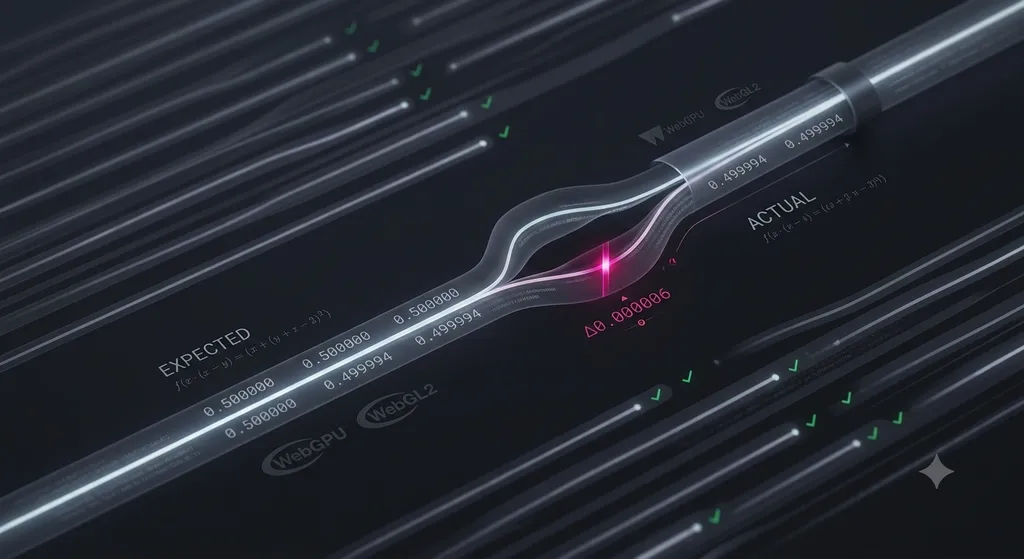
sRGB <-> linear round trip: expected 0.500000, got 0.499994 (Δ0.000006, tolerance 0.0001)
GPUTest.tests.js holds the original prototype examples. The rest of the suite covers math, packing, color, BRDFs, tone mapping, and the primitives that turned up bugs.
Choosing a tolerance#
Use assert.eq for values whose contract requires an exact result, closeAbs when the same error bound applies across the tested range, and closeRel for values whose permitted error scales with their magnitude.
Start from the function's numeric contract and account for precision differences between WGSL and GLSL implementations. The fixed sRGB example above uses 1e-4. The fuzz test below uses 1e-3 across the full color range, since it compounds the error from two chained transfer functions. A tolerance should catch a meaningful regression while admitting expected floating-point variation on both backends.
Deterministic input sampling#
gpuFuzzTest runs many generated inputs in one compute dispatch. The following test derives repeatable pseudo-random colors from instanceIndex:
import { hash, vec3, sRGBTransferEOTF, sRGBTransferOETF } from 'three/tsl';
import { gpuFuzzTest } from './gpu-test-utils.js';

gpuFuzzTest( 'sRGB <-> linear round trip (fuzz, 256 random colors)', 256, ( { instanceIndex, assert } ) => {

	const srgb = vec3(
		hash( instanceIndex.add( 1 ) ),
		hash( instanceIndex.add( 1000 ) ),
		hash( instanceIndex.add( 2000 ) )
	);
	const roundTrip = sRGBTransferOETF( sRGBTransferEOTF( srgb ) );

	assert.closeAbs( roundTrip, srgb, 1e-3 );

} );
The GPU generates and evaluates 256 cases; the CPU reads the buffers back, compares each result, and reports failures. Because the inputs come from a hash of the instance index, a failed case can be reproduced in the next run.
Relational helpers apply component-wise to vectors:
gpuTest( 'relational assertions', ( { assert } ) => {

	assert.greaterThan( float( 5.0 ), float( 3.0 ) );
	assert.greaterThanOrEqual( float( 3.0 ), float( 3.0 ) );
	assert.greaterThan( vec3( 5.0, 6.0, 7.0 ), vec3( 3.0, 3.0, 3.0 ) );

} );
Running the tests#
Place GPU tests under test/unit/addons/tsl/ in a Three.js checkout, then run the headless add-on suite:
npm run test-unit-addons
Use the headful runner to inspect browser and GPU failures:
npm run test-unit-addons-headful
Puppeteer provides the existing browser test environment, so the GPU tests needed no separate CI job — the per-backend detection described above already handles machines that expose WebGPU, WebGL2, or both.
Six bugs from the first test pass#
Tests added while developing vector and matrix support found six defects, spanning expression authoring, type resolution, backend code generation, and node caching — none of them exposed by rendered demos.
Shader expression bugs#
gain()selected one branch for every input, andpcurve()returnedNaN. The implementation used a JavaScript ternary with a TSL node as its condition. JavaScript treats the node object as truthy.pcurve()also used the native/operator on a node expression.sinc()evaluated0/0at its peak. Its removable singularity producedNaNat runtime and could prevent WGSL compilation for constant inputs. Thesinc(1/k, k) == 1assertion in the test above is the case that failed.
Matrix conventions and type metadata#
rotate()built its 3D matrices in the wrong direction. The implementation treated thevec4arguments tomat4(...)as rows. TSL uses them as columns.determinant()reported a matrix return type.determinant(mat3)returns a scalar, whilegetNodeType()returnedmat3.
Backend generation and graph caching#
faceForward()failed to compile on WebGPU. The WGSL method table lacked an entry for the camel-case built-in.- A
TempNodecache reused an uninitialized value across sibling branches. The cached read produced zero. Its fix exposed a second crash that the first defect had masked. This PR remained open when I published this post; the other fixes had merged.
The merged harness supports scalars, vec2 through vec4, mat3, and mat4. If you find an unsupported TSL case or have feedback on the API, let me know!