GTA 6 Graphics Rendering: What We Know So Far
GTA VI is the biggest entertainment launch ever and it sets a new bar for real-time graphics. Rockstar has not published how it works. This is my best estimate of how RAGE renders a frame, stage by stage, and what changes on each console.
Ben Houston • • 25 min read
Grand Theft Auto VI is out. Take-Two reports $3.79 billion in first-day sales, the biggest launch of any entertainment product in any medium.
It also looks incredible. Digital Foundry titled its pre-release analysis "perhaps the most impressive showcase we've ever seen in real-time rendering", and many people are saying the game sets a new bar for graphics. They are right.
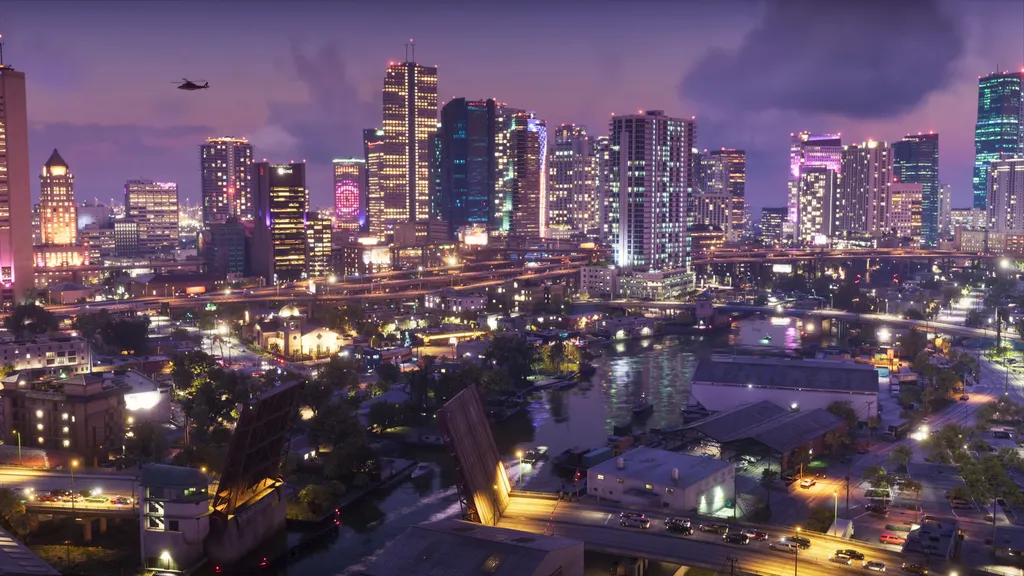
Rockstar has not published how it does it. This essay is my best estimate of how the RAGE engine renders a frame of GTA VI, built from what is public today:
- Rockstar's formal interviews, mainly the technical statement from its technology leads and an art team interview.
- Posts by Rockstar graphics programmers describing what they worked on.
- Digital Foundry's analyses of the shipping game on all four consoles.
- A datamined table of the graphics settings for each console. Rockstar has not authenticated it.
- Published research and talks from comparable open-world console renderers.
I come at it from two other angles as well. The first is lineage. Adrian Courrèges's GTA V graphics study and imgeself's Red Dead Redemption 2 graphics study took captured RAGE frames apart pass by pass, and engines evolve, they are not rewritten. There is no GTA VI frame capture to take apart yet, so this study works from evidence instead. The second is the hardware: each console has a known amount of memory, memory bandwidth and GPU power, and the whole frame has to fit in 33.3 ms.
I think the result is close. I do not know the new optimizations Rockstar invented, and there are surely many. What I can give is the outline: what happens in a frame, in what order, and what differs between the consoles.
The frame at a glance#
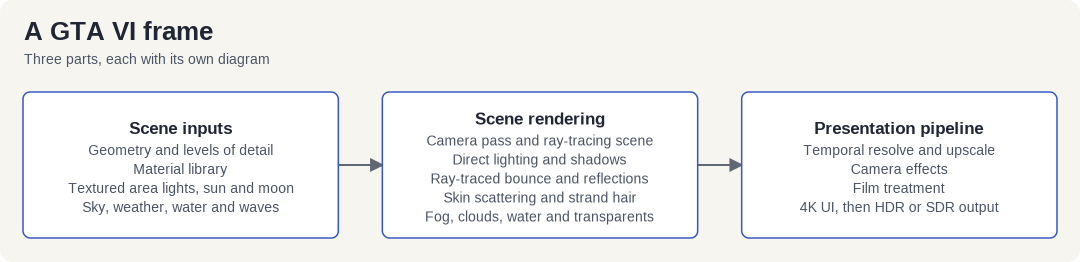
GTA VI starts each frame by rasterizing the world from the camera into depth and material buffers. RAGE then lights those surfaces with textured area lights and shadows, adds ray-traced diffuse bounce light and glossy reflections, finishes the characters' skin and hair, and composites water, particles and the atmosphere into the scene image. A cinematic imaging pipeline and a console-specific upscaler prepare the picture for display. The UI goes on last.
The confidence column is my estimate that the description of that stage is substantially right.
| Stage | What RAGE produces | Confidence |
|---|---|---|
| 1. Camera and ray-tracing scenes | Camera depth and surface data, plus a bounding volume hierarchy for rays | 85% |
| 2. Direct lighting and shadows | Direct light from the sun and textured local emitters, shadowed by shadow maps | 80% |
| 3. Diffuse bounce light | A denoised, reduced-resolution ray-traced indirect lighting signal | 65% |
| 4. Glossy reflections | Low-resolution ray-traced reflections with screen-space detail on top, plus planar mirrors | 85% |
| 5. Sky, clouds and lit fog | Sky and cloud radiance, plus scattering and transmittance along the view | 85% |
| 6. Skin and hair | Subsurface scattering on skin, and strand hair composited over the lit scene | 70% |
| 7. Water and compositing | An HDR scene image with opaque surfaces, hair, water, transparencies, particles and atmosphere | 60% |
| PS5 Pro | The same scene with ray-traced shadows and higher ray-tracing tiers | 85% |
| Presentation | The display image, with cinematic treatment, reconstruction and UI | 80% |
The stages describe data dependencies. The engine can run lighting and atmosphere work in parallel, reuse data across frames, and fuse passes. The exact pass order and buffer layout are not public.
The consoles#
GTA VI targets 30 fps on four consoles that share an eight-core AMD Zen 2 CPU. That gives the entire frame about 33.3 ms.
| Console | Peak GPU compute | Memory | Memory bandwidth |
|---|---|---|---|
| PS5 Pro | 16.7 TFLOPS | 16 GB GDDR6 + 2 GB DDR5 | 28% faster than PS5 |
| PS5 | 10.3 TFLOPS | 16 GB GDDR6 | 448 GB/s |
| Xbox Series X | 12 TFLOPS | 16 GB GDDR6 | 10 GB at 560 GB/s, 6 GB at 336 GB/s |
| Xbox Series S | 4 TFLOPS | 10 GB GDDR6 | 8 GB at 224 GB/s, 2 GB at 56 GB/s |
All four support hardware ray tracing, and Rockstar uses it on all four. Its technical statement says the same lighting solution runs on every console, including Series S, "where memory pressure posed a bit of a challenge."
The 30 fps cap comes from the CPU. Marc Chambers of Rockstar says even the Pro's processor cannot run the simulation faster. So the Pro's extra GPU power cannot become frame rate. It goes to image quality.
What goes into a frame#
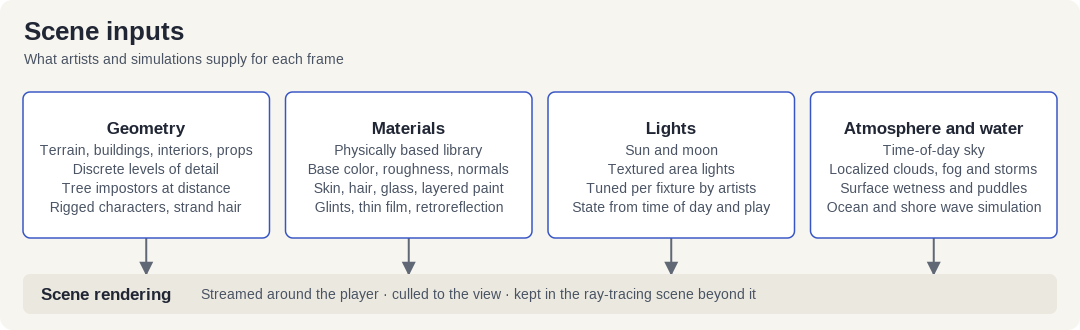
Before the renderer does anything, artists have built what it draws.
Geometry. Terrain, buildings, interiors, vegetation, props, characters and vehicles, each with detailed meshes for close views, simpler levels of detail for distance, and impostors for far trees. Digital Foundry finds discrete levels of detail with smooth transitions and no sign of virtualized geometry in the style of Nanite. It also reports strand-based hair on essentially every character, pedestrians included.
Materials. Rockstar built a new physically based material library for the game. Its graphics programmers name several specialized shading models: a dual-specular BRDF, diffraction gratings and thin-film interference for iridescent paint and oil slicks, retroreflection for road signs at night, and glints on roads and sand (Victor Avila Parcet, Oguzhan Karakaya).
Lights. Rockstar calibrated its lights against real natural and artificial sources. Emilio López, who worked on direct lighting, writes that "most lights are textured area lights", each with a finite emitting surface and a texture that varies emission across it, and each tuned by artists for its surroundings. A storefront sign, a fluorescent tube and a streetlamp produce different pools of light and different reflections on the same pavement. The lights are also dynamic: streetlights warm up at dusk, damaged bulbs flicker, and fixtures can be shot out.
Sky and weather. The game is set in Leonida, a fictional state modeled on Florida, and its weather is local. Game Informer reports one area can be sunny while another is under heavy rain, and puddles persist after the storm. At night the city lights the clouds from below, and Ángel Ortiz lists light pollution and aerial perspective among the sky features.
The base pipeline#
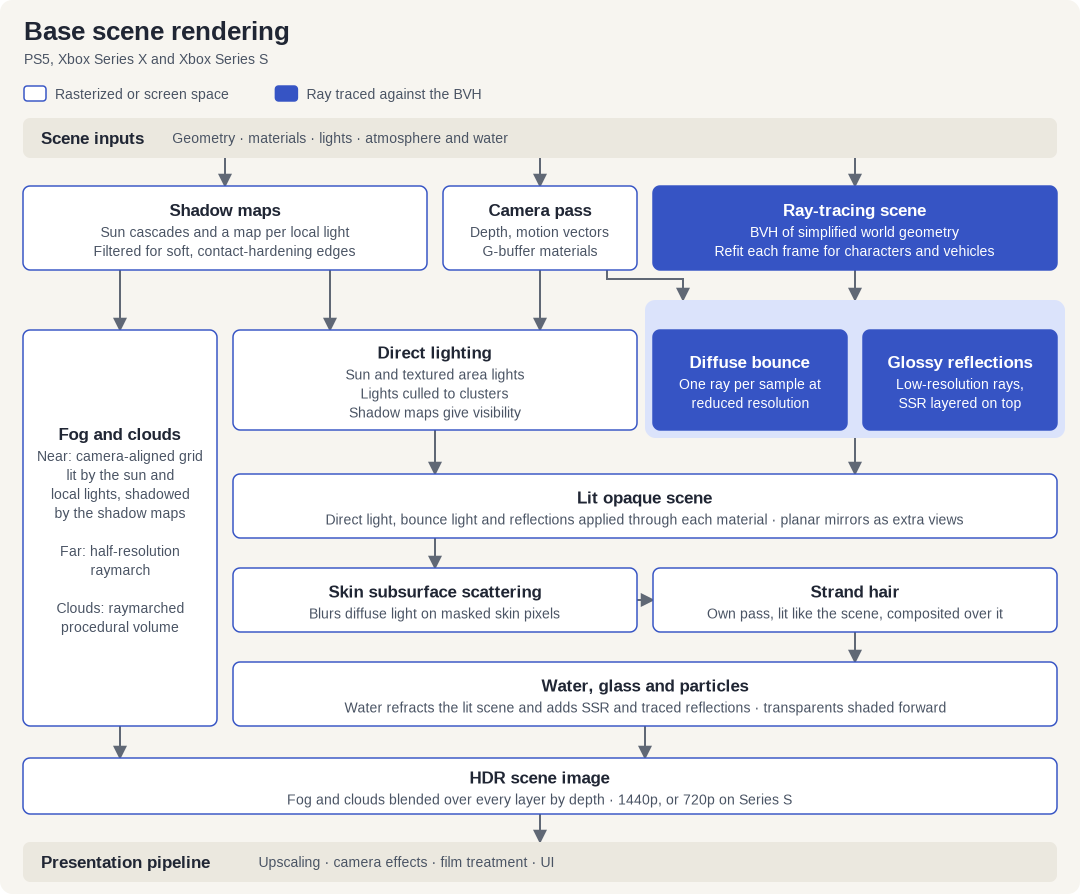
PS5, Xbox Series X and Xbox Series S render the scene the same way. Series S runs it at 720p with lower tiers for the ray-tracing scene, shadows and volumetric lighting.
1. Build the camera and ray-tracing scenes#
RAGE streams geometry and textures around the player, culls what is outside the view, and picks a level of detail for the rest. Nearby surfaces can use tessellation, and parallax occlusion mapping makes pavement and stone look recessed without adding triangles. Both carry over from RDR2's settings.
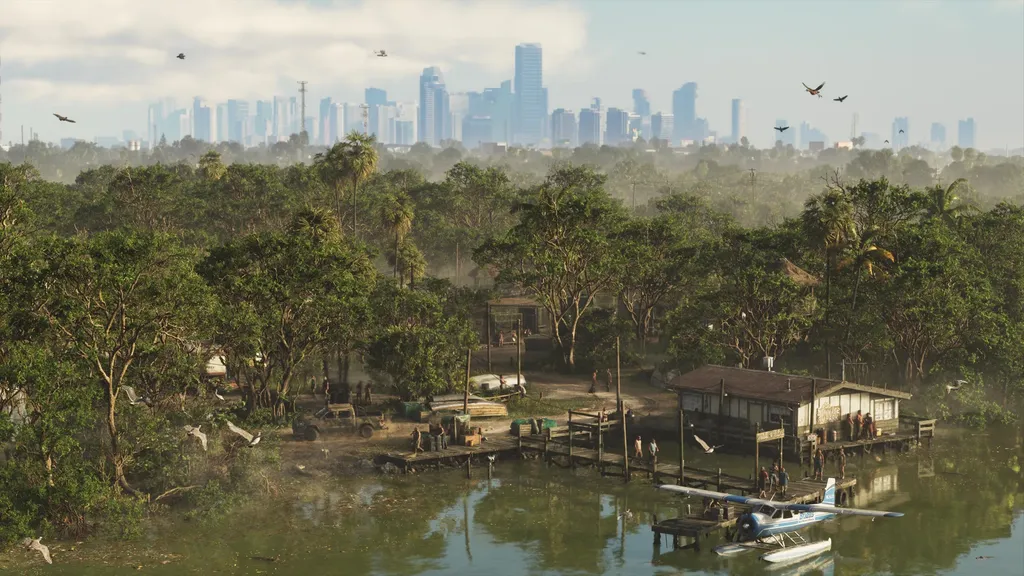
The opaque pass rasterizes the nearest surfaces into a depth buffer and a G-buffer, a set of textures holding the material properties at each pixel. Lighting is then evaluated from those buffers. This is deferred shading, as in GTA V and RDR2, and Karakaya mentions working on a deferred shadow resolve system. The pass also flags skin pixels in the stencil buffer, as GTA V did, for the skin step in stage 6. Glass and other transparent materials are drawn later in forward passes, and hair gets a pass of its own.
Alongside the camera view, the engine maintains the ray-tracing scene. A bounding volume hierarchy (BVH) lets a ray skip whole groups of geometry by testing their bounding boxes first. Rays for bounce light and reflections need the world outside the camera view too. Digital Foundry sees animated characters in off-screen reflections and characters contributing bounce light, so skinned meshes are in the BVH and are refit as they move.
The datamined BVH quality tier is High on PS5 and Series X and Low on Series S. Other open-world console renderers fit the scene into memory with lower-detail meshes and a shorter coverage distance, and that is what I expect these tiers control. Ubisoft's Assassin's Creed Shadows talk reports about 320 MB of acceleration structures. A BVH does not shrink with rendering resolution, which is why memory is the hard part on Series S.
2. Apply direct lighting and shadows#
The renderer evaluates the sun as a directional light and shades each surface with the local lights that reach it. To bound the work in a dense scene like Vice City at night, each light is first assigned to the screen tiles or 3D clusters it can affect, as in RDR2.
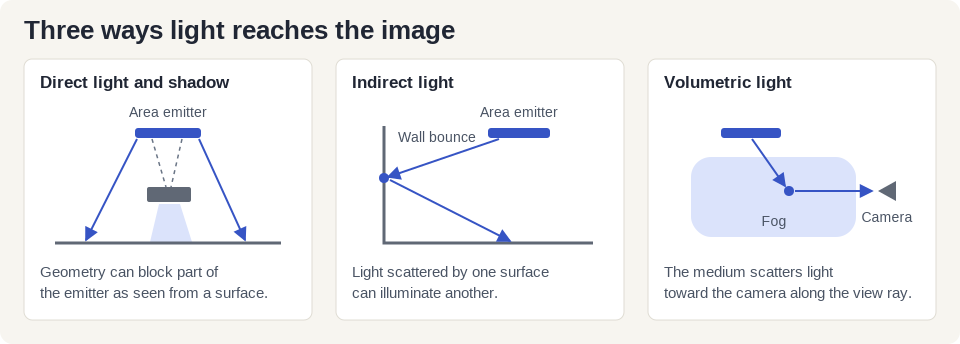
For a textured area light, the shader estimates the material's response across the emitter's surface, weighted by its emission texture. Linearly transformed cosines are the standard way to do this efficiently for polygonal lights. That integral is unshadowed. Visibility is a separate term multiplied in.
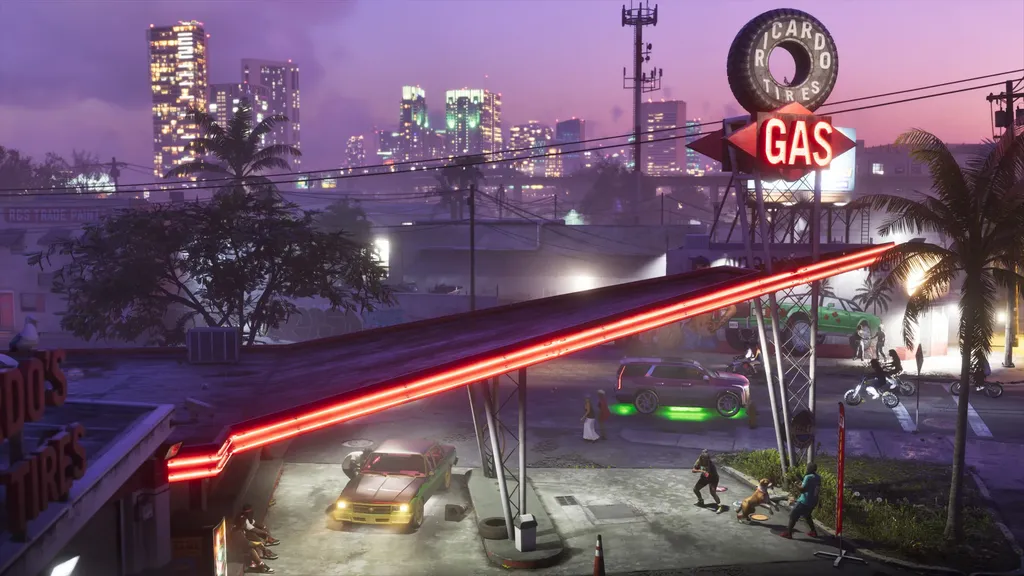
On the base consoles, visibility comes from shadow maps. The renderer stores depth from the light's point of view and compares each shaded point against it. The sun uses cascades, with finer maps near the camera. Digital Foundry describes the result as closely derived from RDR2, with variable penumbra, occasional aliasing and visible cascade steps. Edges that are sharp at contact and soften with distance point to a PCSS-style filter, which GTA V offered on PC.
Many local lights cast shadows, even on the base consoles. López mentions "a specific bit of tech for local light shadows" and does not say what it is. The common way to afford that many is to cache the shadow maps of static fixtures and update only a few per frame. Colored glass also tints the shadow it casts, on every console except Series S.
3. Add diffuse bounce light#
Ray-traced global illumination (RTGI) estimates the light that arrives at a surface after bouncing off the rest of the scene. In a neon-lit alley, rays from the pavement hit a colored wall, pick up its reflected light, and carry it back. The same rays find shelter from the sky and geometry outside the camera view.
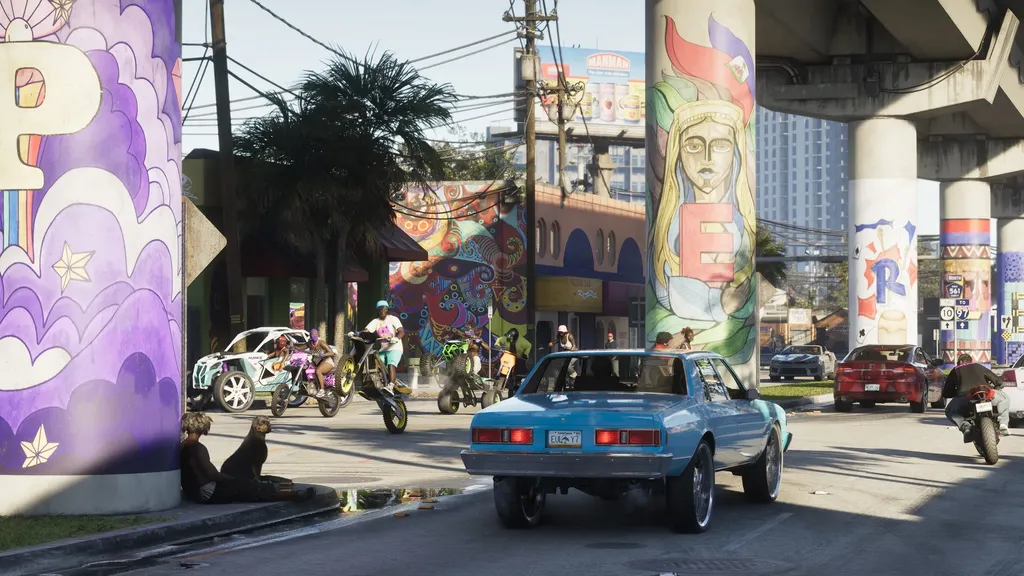
This is the stage I am least sure of. Hardware-traced, denoised GI on all four consoles is well supported. Rockstar has not said where the rays start or how their hits are lit.
My estimate is a per-pixel diffuse gather at reduced resolution, with its own denoiser:
- Pick about one ray direction for a quarter to a half of the visible pixels.
- March the ray against camera depth first, where a hit can reuse the already lit image.
- Continue into the BVH when the screen has no answer.
- Light the hit cheaply, with simplified materials, and read further bounces from a small world-space cache.
- Accumulate over time and filter with depth and normal awareness, then spread the result to full resolution.
Several observations point this way. Digital Foundry describes the RTGI in GTA V Enhanced, the closest RAGE precedent, as per pixel. In GTA VI it reports fine contact-scale indirect shadowing, bounce light from small objects and characters, no light leaks, and a flashlight whose bounce is reactive but noisy. It also sees denoising artifacts when a door opens onto a dark room. A slowly converging world-space probe grid would lag and leak in those cases. A screen-probe gather, as in Ghost of Yōtei, is the credible alternative.
It also fits the budget. Massive's Snowdrop and Ubisoft's Assassin's Creed Shadows both ship this design on consoles. They trace one ray per pixel at a quarter of the pixel count and spend about 3 to 7 ms on it at 1440p, much of it on hit lighting and denoising.
The datamined GI tier is Medium on all three base consoles. Series S gets its savings from the 720p scene and the lower BVH tier, and Digital Foundry finds its GI somewhat messier.
4. Resolve glossy reflections#
Reflections are a hybrid. RAGE sends a limited set of reflection rays through the BVH to recover what the camera cannot see, and layers screen-space reflections (SSR) on top wherever the camera's own depth and color provide a hit. Digital Foundry identifies that layering in storefront glass on every console. It finds ray-traced reflections even on quite rough surfaces, where they turn noisy and blotchy in motion. That points to few samples and a dedicated denoiser.
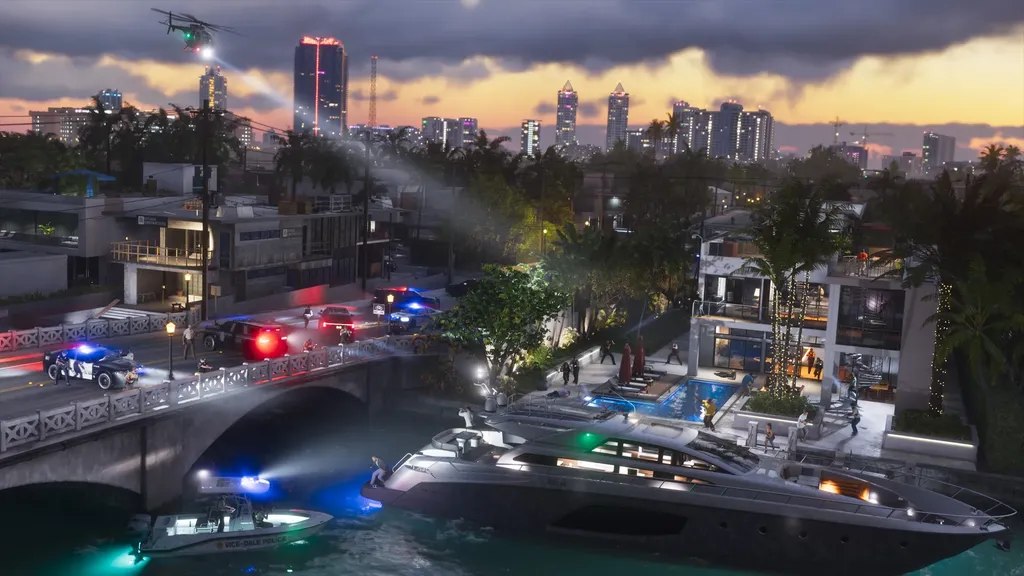
The traced reflections are economical. Digital Foundry describes them as low resolution, drawn from a simplified scene, and often missing shadows and GI detail at the reflected surface. That is the usual console budget: trace at reduced resolution, against lower-detail geometry, with cheap lighting at the hit.
Mirrors are a separate path. Digital Foundry sees planar reflections on many of them, where the engine renders the scene a second time from a camera reflected across the mirror. Karakaya describes mirror reflections as one of his main contributions, and the settings carry a mirror quality tier of their own, as GTA V and RDR2 did.
A cubemap is the likely fallback for distant scenery, the sky, and rays that miss. GTA V and RDR2 both used cubemap captures, and the datamined settings still carry RDR2's name for them.
5. Render sky, clouds, and lit fog#
RAGE evaluates a time-of-day sky and an atmosphere that varies across the map. The clouds are procedural and volumetric, and the player can fly through them.
Rockstar's art team says the volumetrics started from the system built for RDR2, which Rockstar published at SIGGRAPH 2019. It has two parts:
- Near the camera, a camera-aligned 3D grid of 160×88×64 cells, reaching 160 m. Each cell evaluates the sun and the local lights, with visibility from the existing shadow maps. That visibility is what shapes light shafts.
- Beyond the grid, a half-resolution raymarch steps through the medium toward the surface or the sky, accumulating scattered light and tracking how much of the background survives.
The datamined settings still have separate tiers for volumetric lighting and raymarching, under RDR2's setting names.
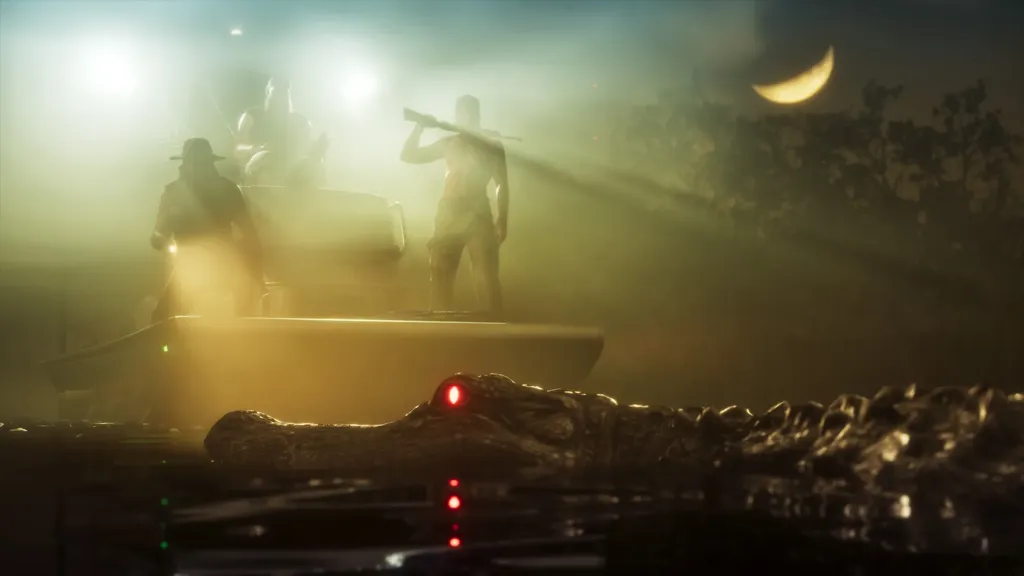
RDR2's far raymarch left out local lights to save time. López writes that in GTA VI "nearly all local lights have volumetrics, including at long distance", and that most are shadowed. That is the old limit being removed, and it is where the new, undocumented work sits. It is a large part of why Vice City at night keeps its mood into the distance.
6. Finish characters: skin and hair#
Characters go through the stages above like everything else. Two steps then finish them, once the opaque scene is lit and before water and fog go on top.
Skin. Light enters skin, scatters under the surface and leaves a short distance away. That softens the shading and lets light glow red through thin parts like ears. In a deferred renderer this is a separate screen-space pass that runs after the opaque scene is lit. The lighting keeps diffuse light apart from specular on the skin pixels flagged in stage 1. The pass blurs that diffuse light with a kernel shaped like skin's scattering profile and scaled by depth, then adds the specular highlights and reflections back sharp. It has to run before water and fog, or they would bleed into the blur. Separable subsurface scattering is the standard reference.
RAGE has done this before. The GTA V graphics study shows a subsurface scattering pass right after the lighting is combined and before water, applied to the player and to pedestrians. In GTA VI, Digital Foundry points out the subsurface scattering on Jason's ears. The dual-specular BRDF that Avila Parcet names is how skin's highlights are usually modeled: one tight lobe and one broad lobe for the oily surface.
Hair. Digital Foundry calls hair possibly the game's most impressive visual system. It is strand-based and physics-driven on basically every character, pedestrians included, and it is the same system in gameplay and cutscenes. It has a convincing specular sheen and soft self-shadowing. It clumps and turns glossy when wet, and wind catches it.
A strand is thinner than a pixel, so hair cannot go through the G-buffer like an opaque surface. It touches the frame in three places:
- Before rendering, the strands are simulated and their geometry is built on the GPU.
- In the shadow pass, hair casts shadows like other geometry, and gets a self-shadowing term of its own inside the hair volume.
- After the opaque scene is lit, the strands are drawn in their own pass, shaded with a hair model using the same lights, shadows and bounce light, and composited over the scene.
The lighting itself treats each strand as a thin, translucent fibre. A strand has no useful surface normal, only a direction, so the shading works from the angles between the light, the view and the strand. The standard model, from Marschner and co-authors, splits the light into three paths:
- Reflection off the outside of the fibre, which is the white highlight.
- Transmission straight through it, which is the glow when hair is backlit.
- Internal reflection off the back wall, which is a second highlight tinted by the hair's color.
Two more terms make hair look soft instead of like a helmet. Shadowing is partial: it measures how much hair the light passed through, not just whether something is in the way. And in light-colored hair, light bounces between many strands before leaving, which games approximate with a technique called dual scattering. Bounce light from stage 3 goes through a simplified version of the same model.
Hair also writes depth and motion vectors, so fog, depth of field and the temporal resolve treat it correctly. Its sub-pixel coverage is left for that final temporal pass to resolve. How RAGE rasterizes and shadows the strands is not public.
The cost is real. Digital Foundry suspects hair is one of the reasons a 60 fps mode was off the table. Series S keeps the system at a lower resolution, where facial hair turns blurry.
7. Shade water and composite the scene#
Water is shaded in its own pass, which reads scene depth and the already lit opaque image. The wave simulation bends the reflection and refraction directions, a Fresnel term strengthens reflection at grazing angles, and the depth difference under the surface sets how much the water absorbs. The programmer who worked on the ocean lists the water BRDF, underwater volumetrics, caustics above and below the surface, and the water's diffuse and specular GI.
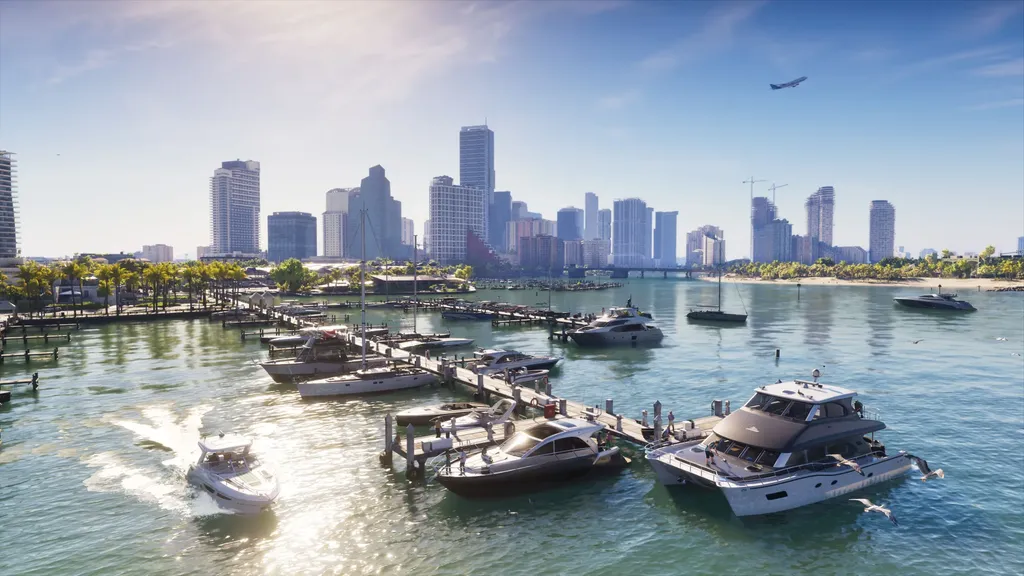
Water reflections combine sources. Screen-space reflections handle what is on screen, and the ray-traced specular GI supplies what is off-screen or hidden. In pre-release footage, Digital Foundry saw building reflections on water that held up where SSR would fail.
The datamined settings also list a 512×256 water reflection resolution. RDR2 had a water-reflection pass at exactly that size, which raymarched the atmosphere along reflected directions so the water could reflect clouds. I expect it does the same job here.
Finally the renderer combines the lit opaque world and hair with water, glass, spray and other particles into the HDR scene image, and applies the fog. Each transparent layer needs the fog at its own depth, so a particle in front of a window gets a different amount than the scenery behind it.
The PS5 Pro pipeline#
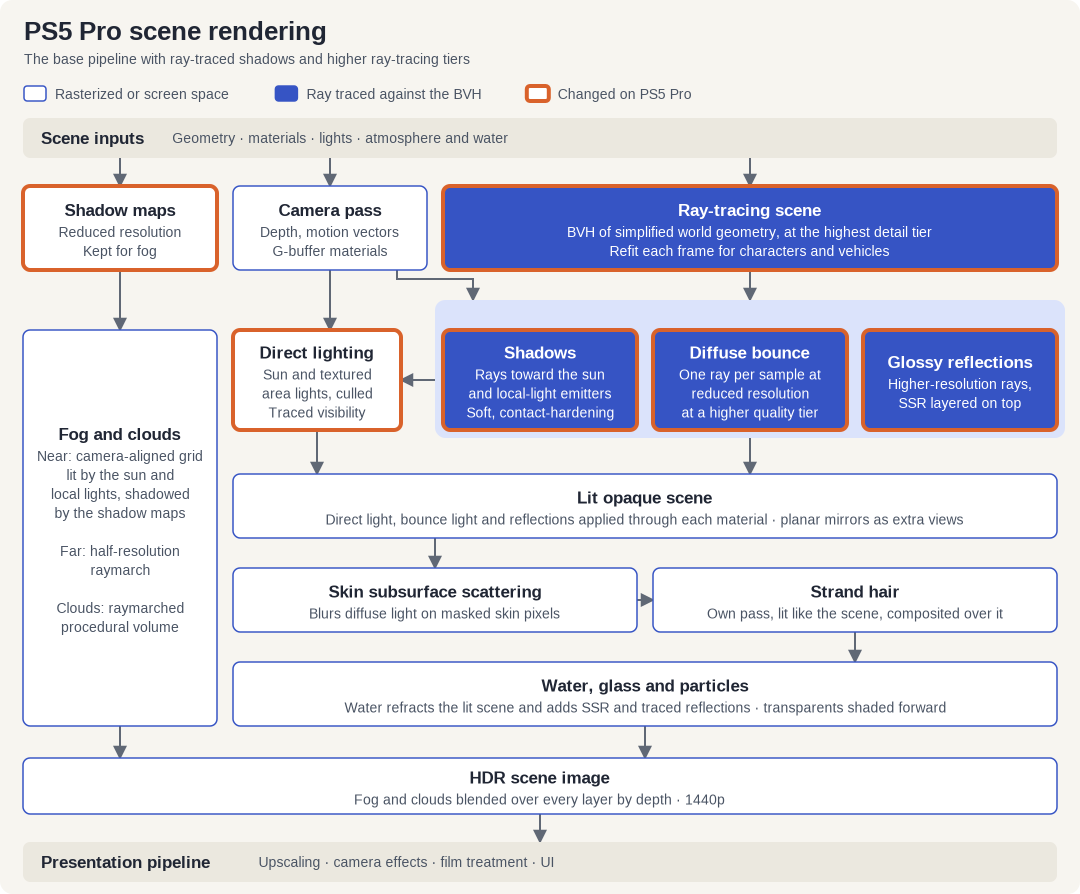
PS5 Pro runs the base pipeline at the same 1440p with three changes.
Ray-traced shadows. Sony and Rockstar confirm them, and Digital Foundry sees them on both the sun and local lights. Tracing toward points on a finite emitter gives shadows that are sharp at contact and soften with distance, and removes the stepping of a shadow map. GTA V Enhanced traced only the sun. In the datamined Pro profile the ray-traced shadow tiers are High and the conventional shadow tiers drop to Low. The shadow maps are demoted, not removed. I expect they still serve the fog grid and particles.
Higher ray-tracing tiers. BVH quality rises from High to Ultra and global illumination from Medium to High. Digital Foundry finds reflections modestly cleaner and higher in resolution. The economies remain: reflected surfaces still often lack shadows.
PSSR 2 replaces Rockstar's TAA for reconstruction, covered next.
Sony quotes the Pro's ray tracing at two to three times the speed of the base PS5. That is what makes a third traced effect affordable.
The presentation pipeline#
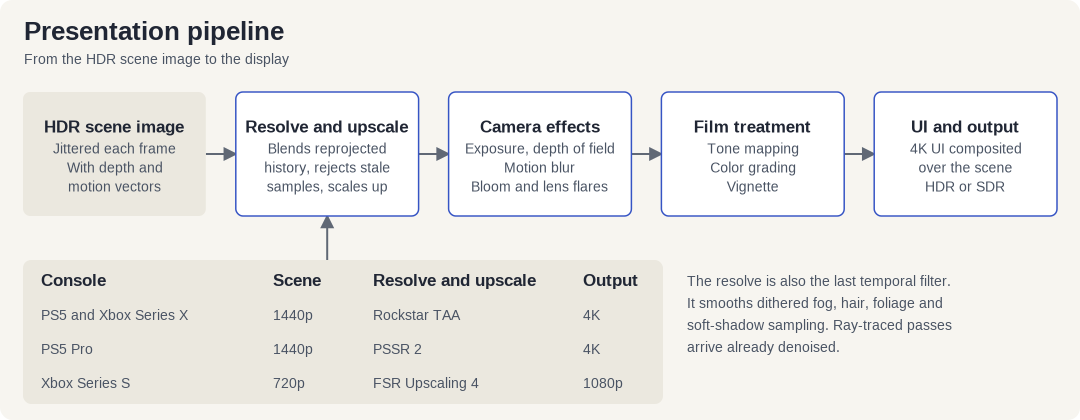
Rockstar describes "an imaging pipeline modelled after real world cinematic camera and film treatment." Arthur Marques Medeiros lists work on the exposure systems, bloom, lens flares and depth of field. Tone mapping and color grading translate scene lighting into the brightness and color range of an HDR or SDR display. There is also a vignette, which Rockstar confirms is an artistic choice.
Reconstruction differs per console. Rockstar states the numbers outright:
| Console | Base scene | Output | Reconstruction |
|---|---|---|---|
| PS5 Pro | 1440p | 4K | PSSR 2 |
| PS5 | 1440p | 4K | Rockstar's in-house TAA |
| Xbox Series X | 1440p | 4K | Rockstar's in-house TAA |
| Xbox Series S | 720p | 1080p | AMD FSR Upscaling 4 |
Temporal anti-aliasing combines jittered samples from the current frame with previous frames reprojected by motion vectors. Digital Foundry measures a fixed 1440p on the larger consoles with no dynamic resolution. It finds that PSSR assembles a real 4K image from multiple frames on Pro, while the base PS5 and Series X image looks like 1440p. So Rockstar's TAA mainly anti-aliases and stabilizes the 1440p scene, and adds little detail on the way to 4K.
The UI is composited at 4K after upscaling on all four consoles, including Series S.
This final temporal pass is also the last of several filters that hide sparse sampling. RDR2 dithered its volumetric lookups and left TAA to stabilize them, and hair, foliage and soft-shadow filtering rely on it the same way. The ray-traced GI and reflections are different. At one ray per sample their noise is too strong for TAA alone, so they are denoised first, and Digital Foundry still sees the residue on rough metal and in dark interiors.
Does it fit?#
An estimate like this should survive arithmetic, so I built the GTA VI Frame Calculator (source). It models the buffers, resident scene data and memory traffic of the pipeline above on each console, with every assumption editable.
| Console | Frame buffers | Resident scene | Modeled memory / budget | Memory traffic at 30 fps |
|---|---|---|---|---|
| PS5 | 525 MiB | 5.75 GiB | 7.77 / 12.5 GiB | 86.5 GB/s |
| PS5 Pro | 555 MiB | 6.00 GiB | 8.05 / 13.7 GiB | 95.8 GB/s |
| Xbox Series X | 525 MiB | 5.75 GiB | 7.77 / 13 GiB | 86.5 GB/s |
| Xbox Series S | 154 MiB | 3.55 GiB | 4.90 / 7.8 GiB | 23.0 GB/s |
The pipeline fits in memory and bandwidth on every console. Frame buffers are small next to the world data, so the real totals depend on how much of Leonida the game keeps resident. That is surely more than I modeled, given Rockstar's comment about Series S.
Skin and hair are a small part of it. At 1440p their render targets come to about 84 MiB, and I allow 192 MiB for strand geometry.
The binding constraint is GPU time. Published timings from shipped console renderers put quarter-resolution diffuse GI at 3 to 7 ms at 1440p and reflections at 3 to 4 ms. With BVH upkeep, ray tracing takes roughly 10 ms of the 33.3 ms frame. Tracing both at full resolution would cost about four times as much and would not fit.
The same arithmetic leaves no room for ray-traced shadows on the base consoles and several milliseconds for them on PS5 Pro. That is exactly what shipped.
Series S renders a quarter of the pixels, which cuts shading, buffers and screen-driven ray work. The BVH and its caches do not shrink, so the Low BVH tier is there to save memory. Ubisoft dropped ray-traced GI on Series S in Assassin's Creed Shadows for that reason. Rockstar kept it.
What remains open#
These are the questions I would most like answered, and the footage that would answer them.
| Question | What would settle it |
|---|---|
| Where do diffuse GI rays start? | The error right after a camera cut. Per-pixel grain that settles in a few frames means a per-pixel gather. Blotches several pixels wide mean screen probes. Leaks through thin walls and bounce that lags by seconds mean a world-space probe grid. |
| How are ray hits lit? | Compare a reflected surface with its direct view. Missing shadows and flattened materials in the reflection mean simplified hit lighting from a cache. |
| What does Pro still shadow-map? | Compare fog shafts, particle shadows and distant shadows across PS5 and Pro. |
| What does the 512×256 water target hold? | Watch a cloud reflected in calm water as the camera tilts. A reflection that stays correct at the screen edge but is visibly coarse is the low-resolution target. |
| Do the base consoles reconstruct detail above 1440p? | Compare a static scene with a slow pan on PS5. Detail that resolves only at rest would show temporal upsampling. Digital Foundry currently sees none. |
Rockstar's graphics team will hopefully present this work themselves, as they did for RDR2's atmosphere. Until then, this is the frame as best I can reconstruct it. If you worked on it, or you have captures that settle one of these questions, I would love to hear where I am wrong.