Frameworks vs. Toolkits for Multi-Market SaaS
Why SaaS products that stretch one opinionated framework across multiple markets often become harder to use, and why scalable multi-market products separate universal toolkit primitives from market-specific frameworks.
Ben Houston • • 9 min read
The framework vs. toolkit distinction is well understood in the world of developer tools. Rails is a framework. React is a toolkit. Django is a framework. Express is a toolkit. Developers have strong opinions about the tradeoffs.
Far less discussed is how this same distinction applies at the level of SaaS products, and how getting it wrong is one of the most reliable ways to stall a company's growth.
The Terms, Applied to SaaS#
In developer tools, the distinction is about code. In SaaS, it's about the product itself: the data model, the UI, the workflows, the primitives your customers build on.
A SaaS framework is an opinionated, end-to-end product built around a specific workflow. It makes assumptions about what your users are trying to do, how their data is structured, and how they move through their work. That opinion is its strength. It's why framework-style SaaS products are fast to adopt and immediately productive, for the right customer.
A SaaS toolkit exposes composable primitives: databases, query systems, event triggers, connectors, dashboards, UI components, authentication, workflows. It makes minimal assumptions about what you're building. Instead, it gives you the building blocks and lets you assemble them into whatever your domain requires.
Salesforce understood this from the beginning. The Salesforce Platform, originally Force.com, is a toolkit of reusable primitives: a flexible data model, query and reporting systems, workflow automation, event triggers, connectors, dashboards, login and permissions infrastructure. On top of that platform, Salesforce and its ecosystem built application frameworks for specific domains: Sales Cloud, Service Cloud, Marketing Cloud, and thousands of AppExchange products. Each one is opinionated about its domain. But they all run on the same underlying toolkit. When Salesforce added a new cloud product, the platform didn't get more complex. Only the layer above it did.
The infrastructure giants follow the same philosophy in its purest form. AWS, with S3, Lambda, RDS, and SQS, and Cloudflare, with Workers, R2, D1, and Queues, expose atomic, universal primitives that make no assumptions about what you're building; the application frameworks, reference implementations, CDK constructs, and architecture patterns sit on top as optional scaffolding, not as the platform itself.
What these companies share is a commitment to universalist data types and representations. They resist the temptation to optimize their core platform for any specific application or workflow. The primitives are kept clean, interoperable, and domain-agnostic. The opinionated layers, the frameworks, are built on top and kept structurally separate.
When a Framework Is Fine#
Building a SaaS framework is not inherently wrong. If you're targeting a single, well-defined market with consistent needs, a framework is often the right choice. It lets you move fast, make bold product decisions, and deliver an experience that fits your customer's workflow like a glove.
Vertical SaaS is full of successful framework-first companies. A practice management tool for orthodontists. A project management system for ad agencies. A compliance platform for community banks. Each can afford to be opinionated because their customers share enough in common that one set of assumptions serves them all reasonably well.
The framework approach breaks down when you try to apply it across markets that have meaningfully different needs, and that is almost always when growth pressure forces the issue.
The Multi-Market Failure Mode#
This pattern almost never starts as a deliberate architectural choice. It starts as a growth story.
You've had real success in one or two markets. Investors are interested. You raise a significant new round, and the way you've justified that round is by telling a bigger TAM story: you're not just winning Market A and Market B, you're going after Markets C, D, and E. The pitch works. The money arrives. The targets get set. The same dynamic can be triggered by a change of leadership, a strategic pivot, or a board-driven mandate to expand the addressable market. The pressure is the same: move fast into new territory, using what you already have.
Here's how it plays out.
You build a SaaS framework for Market A. It's good. Then Market B presents itself. It looks similar enough: it shares some of your core data concepts, and your product already does most of what those customers need. But it has subtly different workflows. The order of operations is different, certain fields mean slightly different things, a few new concepts need to be introduced. The overlap is real. The differences feel manageable. So you generalize your framework to accommodate both. It works, mostly.
Then Market C arrives. It shares characteristics with both A and B, and again the overlap is genuine. But it has its own marked differences: different terminology, a different process shape, data that doesn't quite map to what you built for A or B. Again the temptation is strong: we're already most of the way there.
That's the trap. The markets are similar enough that reuse feels not just justified but obvious. But the differences between them are real, and every accommodation you make for one market adds complexity that every other market's customers now have to navigate, whether it's relevant to them or not. Market A customers now encounter concepts that only exist because of Market B. Market B customers bump into constraints introduced for Market C. Each market pays a complexity tax for all the others.
With each expansion, you face the same implicit choice: build a new, domain-specific layer on top of your core primitives, or generalize the existing framework further. The second option always feels more efficient. It reuses code. It avoids duplication. It looks clean on a roadmap. And against a backdrop of aggressive new targets, restructuring the core into a genuine toolkit looks expensive and slow. So the needs get bolted onto the existing framework, and that is almost always a mistake.
Every time you generalize an abstraction to serve two different domains, you make it less intuitive for each one. The UI that was once clean and purposeful becomes a negotiation between incompatible workflows. Joel Spolsky's Law of Leaky Abstractions applies here: the more you try to paper over domain-specific complexity with a cross-domain layer, the more the underlying complexity bleeds through in unexpected places. The product almost fits, for everyone, but perfectly for no one.
Meanwhile, a vertical competitor enters Market A with a product that only serves Market A. It's simpler, cheaper, and fits the workflow better, because they've never had to serve anyone else. Suddenly you can't compete on fit in the market you built the company on.
This is how a product that was once excellent becomes unwieldy: not through any single bad decision, but through the accumulated weight of reasonable-seeming compromises, each made to accommodate one more market that was just similar enough to make reuse feel like the right call. The right moment to make the toolkit investment is before the expansion, before the round closes and the new targets are set, not after the product has already been pulled in five directions.
Warning Signs Your Framework Is Being Forced Across Markets#
If you're seeing several of these simultaneously, it's worth asking whether your core product needs to become a platform.
1. Internal roadmap prioritization has become political. Sprint planning feels like a zero-sum negotiation between markets. Features that would serve Market A well conflict with or complicate the experience for Market B. Your product team is spending more time arbitrating between markets than building for any of them.
2. Core concepts in your product have started to mean different things. A term like "project," "account," "workflow," or "asset" means something subtly different depending on which market's customer you're talking to. Your own team has started using context-dependent definitions of your own product's vocabulary.
3. Vertical competitors are beating you on simplicity. A newer, smaller competitor is winning deals in your original market, not on features, but on ease of use. They only serve that market, and their product shows it. This is the most dangerous signal, because it means the market fit you built the company on is eroding.
4. Implementation projects are getting longer. Enterprise deals that used to take weeks to go live now take months, because the product requires significant configuration and workarounds to fit each customer's actual workflow. What you're calling "implementation" is bespoke adaptation work that your product should be doing natively, friction created not by your product's complexity but by someone else's market's complexity leaking into theirs.
5. Someone internally keeps proposing a "v2 of the UI." There's a persistent internal argument that the interface needs a fundamental redesign. This is often a surface-level symptom of a deeper structural problem. The underlying data model and abstraction layer is pulling in too many directions, and no UI redesign will fix it without addressing the root cause.
The Architecture That Scales#
The way out, or better, the way to avoid this trap in the first place, is to separate the toolkit from the frameworks deliberately and structurally.
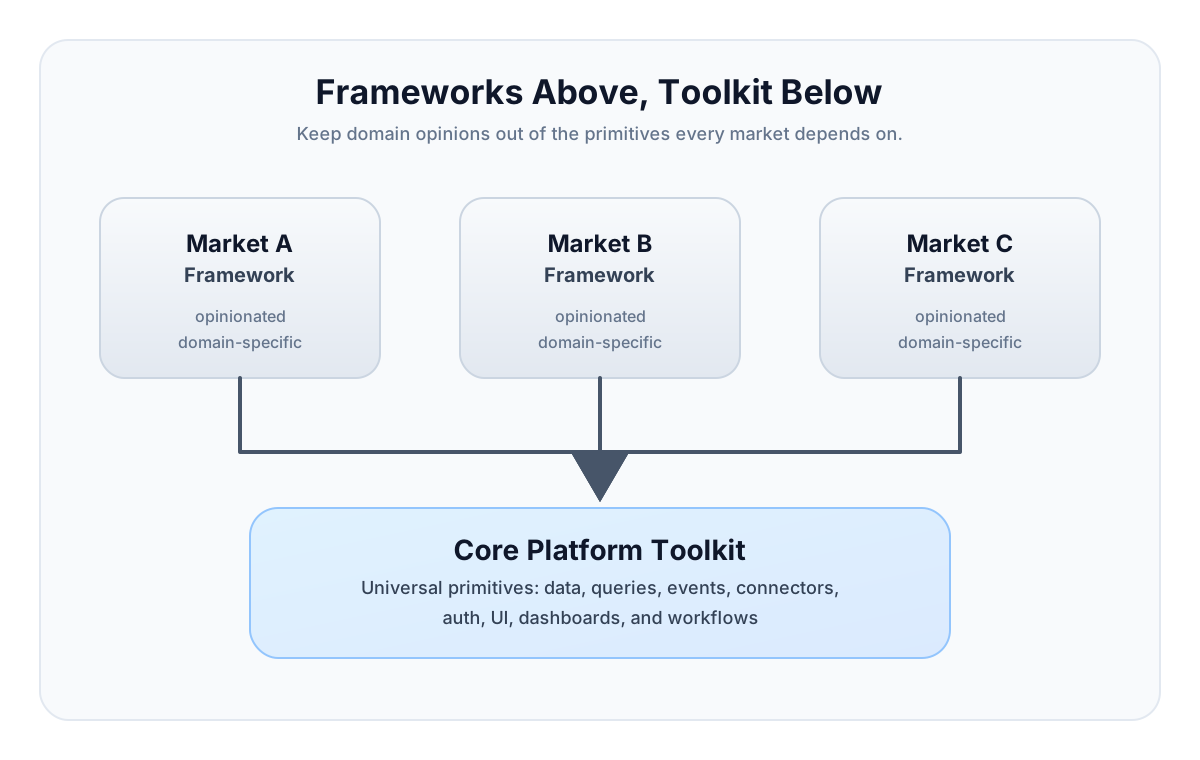
The core platform contains only what is genuinely universal: primitives that are useful across all domains without modification. It evolves slowly and carefully. It is not allowed to accumulate domain-specific opinions.
The market-specific frameworks live above it. Each one is allowed to be opinionated about its domain, because it doesn't have to negotiate with any other domain. Each one is also deliberately malleable, closer to scaffolding or a reference implementation than a rigid structure. Customers can take the framework, reshape it to their specific needs, and extend it using the toolkit's primitives directly.
When you add a third or fourth market, the core toolkit does not become more complex. Only a new framework gets added above it. The blast radius of each market's domain assumptions is contained.
The Practical Implication#
If you're targeting a single, coherent market, a framework approach is probably right. Be opinionated. Optimize for your customer's workflow. Move fast.
If you're targeting multiple markets with meaningfully different needs, even markets that seem related, ask yourself: is my core product a toolkit or a framework? If it's a framework, you have a decision to make before you expand. Extracting genuine primitives from an opinionated framework is hard and expensive. The alternative, continuing to generalize the framework to accommodate each new market, produces a product that is increasingly complex, increasingly hard to use, and increasingly vulnerable to vertical competitors who have the luxury of serving only one domain well.
Frameworks are not the enemy. They give customers a fast path to value and a concrete starting point they can adapt. But they belong above the platform, not inside it. Keep the core a toolkit. Let the frameworks be as opinionated as they need to be. And never let the needs of one market's framework reshape the primitives that every market depends on.
The abstraction has to be honest. Markets, and the customers in them, always find out when it isn't.