Web 3D Survey v2
Web 3D Survey v2 rebuilds the site on TanStack Start, adds homepage support summaries, WGSL and adapter reporting, browser capability stats, and a live /machine report.
Ben Houston • • 3 min read
In 2023 I introduced Web3DSurvey as a replacement for the defunct WebGLStats.com. The mission stayed the same: collect real-world WebGL, WebGL 2, and WebGPU capability data so 3D web developers can pick features from measured support rates.
This year I shipped a large update I call Web 3D Survey v2. It started last summer with a rewrite of the site, then grew into new reporting surfaces for WebGPU, WebGL adapters, browser APIs, and a live machine report. The live site is web3dsurvey.com.
Minor aside: In addition to everything else, I've also migrated Web 3D Survey from Remix to my current favorite stack TanStack Start.
Homepage Report Summaries#
The homepage now shows support summary cards for WebGL, WebGL 2, and WebGPU.
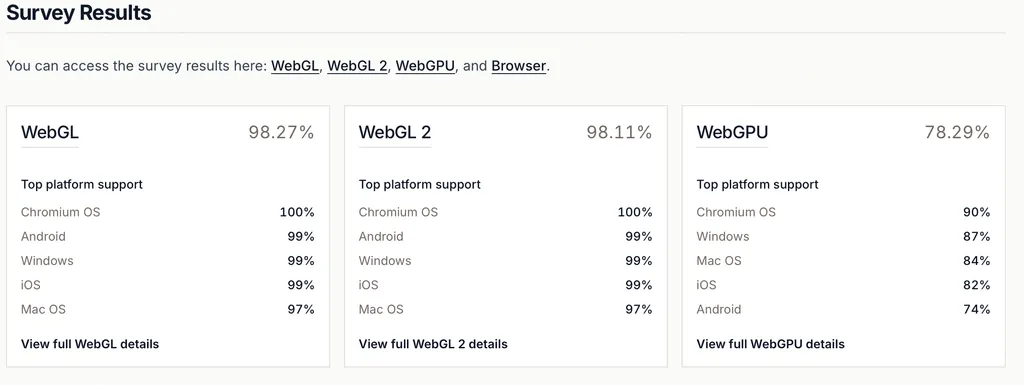
Each card shows an overall support percentage, the top platforms by support rate, and a link into the full report. You get a quick read before digging into extensions, limits, or adapter details.
WebGPU WGSL Language Features#
WebGPU already reported adapter features and limits. v2 also collects WGSL language features from navigator.gpu.wgslLanguageFeatures.
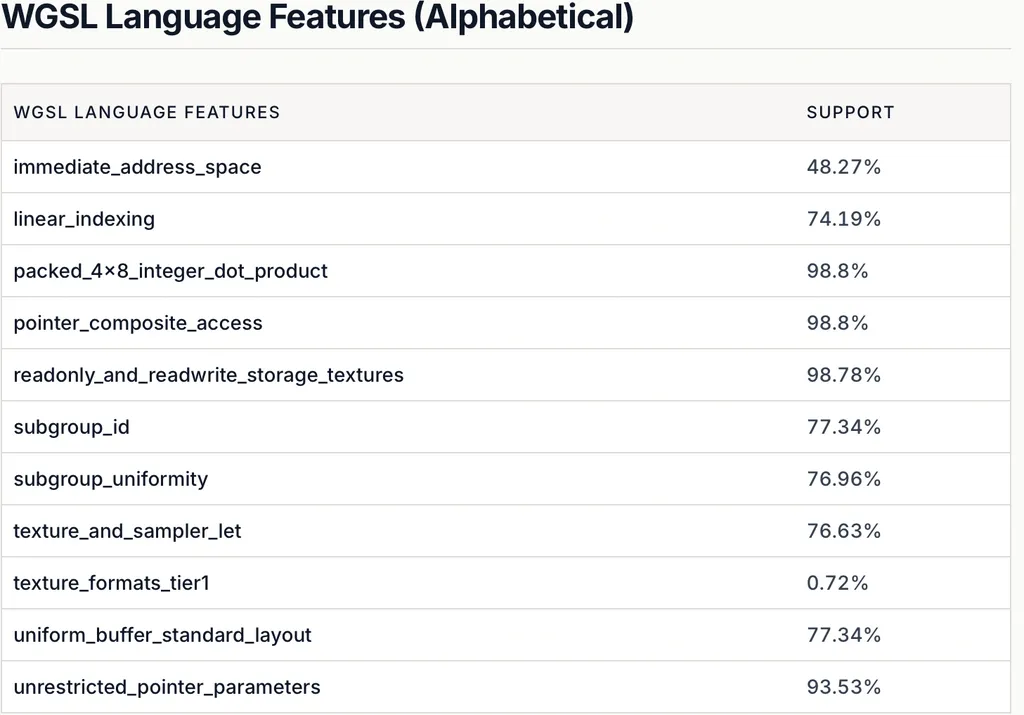
These sit apart from GPU adapter features. They cover language and shading-model capabilities such as packed integer dot products, subgroup uniformity, storage texture access modes, and related WGSL extensions. Each feature has its own stats page under /webgpu/wgsl-language-features/..., with support fractions and platform breakdowns.
Adapter and Renderer Info#
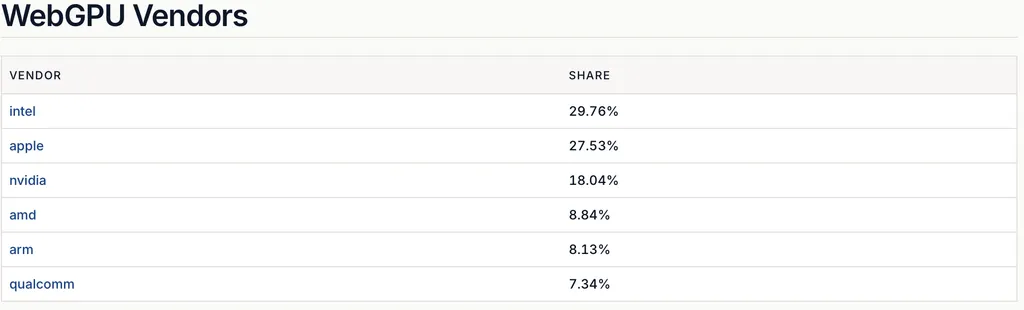
The WebGPU report now aggregates adapter info: vendor, device, architecture, description, fallback adapter status, and subgroup size ranges. See WebGPU vendors for vendor share breakdowns. The WebGL and WebGL 2 reports do the same for renderer info fields like vendor, renderer, shading language version, and related strings.
You can see which GPU vendors dominate the sample, how often fallback adapters appear, and how masked renderer strings look across devices.
Browser Features#
v2 adds a top-level Browser section for capabilities outside the WebGL/WebGPU APIs.
It covers:
- API features such as ImageBitmap, OffscreenCanvas, WebAssembly, Workers, and webdriver detection
- Canvas 2D color space support, including sRGB, Display P3, and HDR-related spaces
- Hardware and display values such as hardware concurrency, device memory, screen size, color depth, and device pixel ratio
Numeric values are bucketed for display so the distributions stay readable. If you build around workers, OffscreenCanvas, or wide-gamut canvas, check support rates here.
Your Machine#
Your Machine is the page I reach for while debugging.
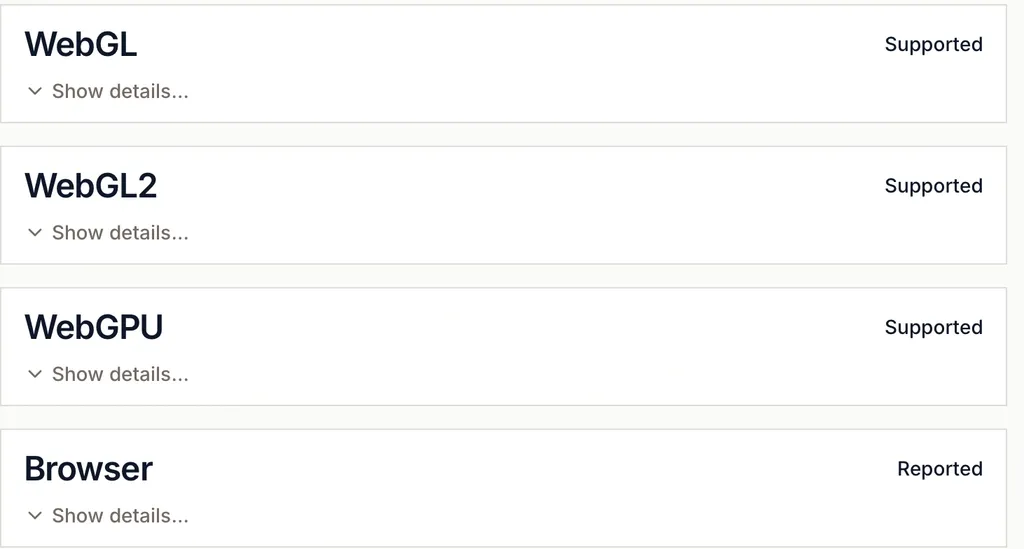
Open /machine and the collector runs against your current browser. You get a live report of what that machine exposes for WebGL, WebGL 2, WebGPU, and browser capabilities. Each row links to the matching survey-wide stats page, so you can compare your device against the population in one click.
I built it as a WebGL Report-style tool wired into the same dataset everyone else contributes to. If you are gating a feature or checking a new laptop before a demo, start there.
Try It#
Visit web3dsurvey.com for the homepage summaries, dig into WebGL / WebGL 2 / WebGPU / Browser reports, or open /machine on the device in front of you.
If you run a 3D web app and want to contribute data, the collector embed is a one-line iframe. Architecture and privacy details are in the original announcement. For how I use this data when shipping 3D apps, see Building 3D Web Apps That Work Everywhere.