Fixing Three.js's Screen Space Reflections
Screen-space reflections in Three.js are approximate, their denoiser hides it, and the result is added on top of a material that has already reflected the environment. These articles set out how shipped engines do it, where Three.js differs, and the changes that close the gap.
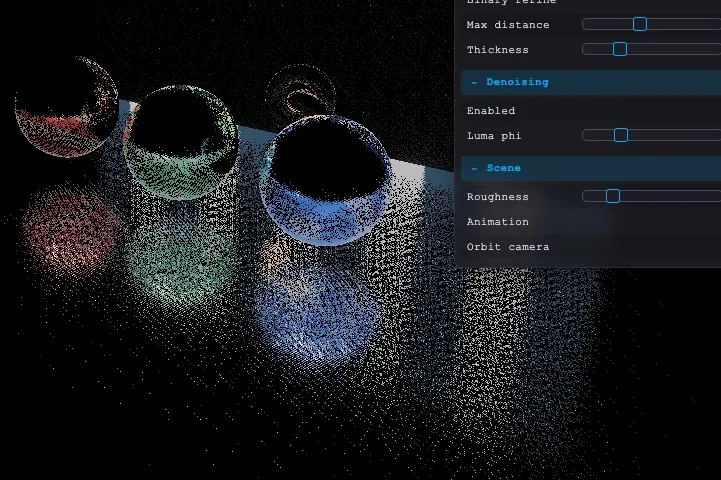
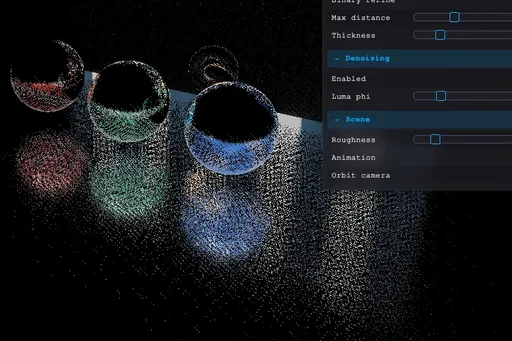
Three.js has screen-space reflections (SSR), and they look acceptable in its examples. They are also wrong in ways that are hard to see and harder to fix one at a time. The tracer misses up to half the reflections it should find. A denoiser paints over the gaps. The result is added to an image that has already reflected the environment map, so every reflection is counted twice.
Shipped engines settled on a way to do this a decade ago. In a modern engine the SSR trace is exact, covers the full screen, and takes less than a millisecond. In Three.js it is approximate, local, and takes 2 to 3 ms. This series measures Three.js against it and works through the changes.
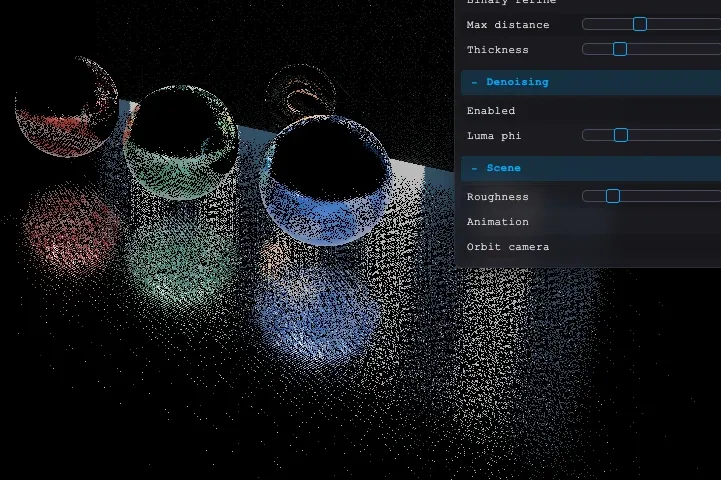
One frame of raw SSR from a Three.js example, before the denoiser fills it in. The black gaps across the floor are rays that should have hit the wall.
The articles#
- The standard, and the gap. How Games Do Screen-Space Reflections, and What Three.js Does Instead sets out the accepted recipe in nine steps, with its sources, and compares Three.js against each one.
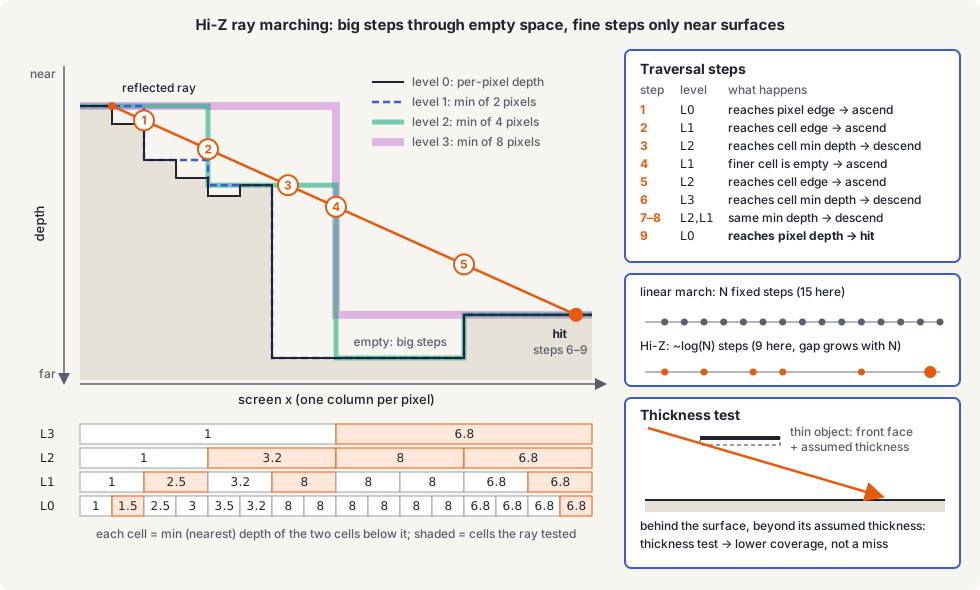
- The tracer. Exact Screen-Space Reflections on a Budget replaces the fixed-step march with depth-pyramid tracing, and pays for it with half resolution and ray reuse.
- The denoiser. How Games Denoise Reflections, and What Three.js Does Instead sets out what shipped denoisers have in common, makes a miss a valid sample with zero coverage, and argues for one denoiser in place of two.
The fourth change is to the material, and it is larger than SSR. Pluggable Indirect Lighting for Three.js, from the Quest for AAA Quality in Three.js series, proposes the hook that lets a reflection reach the material's BRDF with a coverage, and fall back to reflection probes and the environment map where it has none.
Most of the work is prototyped and linked from each article. None of it changes what Three.js does by default.