Ants in the Machine
Communicating swarms of small LLM agents will become as omnipresent in our digital environment as ants are in our biological one.

Communicating swarms of small LLM agents will become as omnipresent in our digital environment as ants are in our biological one.
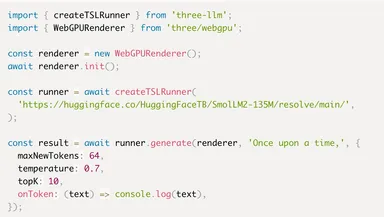
A tour of how language models generate text, how GPT-2 and newer Phi and Qwen architectures differ, and how Three-LLM implements their inference graphs with Three.js TSL compute shaders.
Replace the M5 Max's LPDDR5X with eight Samsung LPDDR5X-PIM packages and the memory could deliver 4.9 TB/s where the weights live. The right parallel mapping could push Llama 3.1 8B toward 650 tokens per second, or a 27B dense model toward 190.

Samsung's LPDDR5X-PIM puts compute inside commodity memory, exposing 614 GB/s of bank-level bandwidth for local LLM inference. The silicon works. Quantization, memory layout, and runtime support now stand in the way.

A small multiresolution feature grid plus a tiny MLP decoder that replaces a stack of correlated PBR textures with one compact, GPU-decoded representation. Named channels with their own activation functions, built on new fp16/half-precision support in TSL, and demonstrated on a MeshPhysicalNodeMaterial. The format is material-agnostic.

A short reference on the neural-network vocabulary used across the neural texture, neural material and neural appearance posts — MLP, weights and biases, ReLU, forward pass, loss, gradient descent, backpropagation, Adam, latent vectors, feature grids and decoder networks — explained once, concretely, so those posts can link here instead of re-deriving it.
Today, I built a pure-TypeScript Zstandard implementation (library + CLI + dictionary training + interop tests) in just 4 hours using OpenAI Codex 5.3.

The story of how I coined the term "exocortex" in 1999 to describe a synthetic cognitive regulator: a technological layer that joins the brain's regulatory hierarchy and helps govern attention and reasoning.

AI coding agents are great at greenfield tasks -- but struggle to maintain or modify existing systems. The problem isn’t the model. It’s the paradigm. This essay makes the case for intent-based programming: a shift from task-driven implementation to declarative specification, powered by systems like Declary.

The Generic Builder is a configurable meta‑builder that creates specialized builders on demand, solving the chicken‑and‑egg problem of intent‑based toolkits. This essay explains its design, the router agent, and a chat‑driven workflow that bridges conversational intent with structured files.
Recursive generation allows intent-based programming toolkits to ingest their own outputs and build entire applications from minimal specifications. This essay explores how recursive intent turns code generation into a compiler-like pipeline that scales small prompts into structured systems.
Traditional specifications failed because they required exhaustive detail. With LLMs, we can now embrace "Sufficient Specification" - providing just enough intent to guide generation without drowning in details. Learn how iterative specification specificity and generator patterns make intent-based programming practical for the first time.